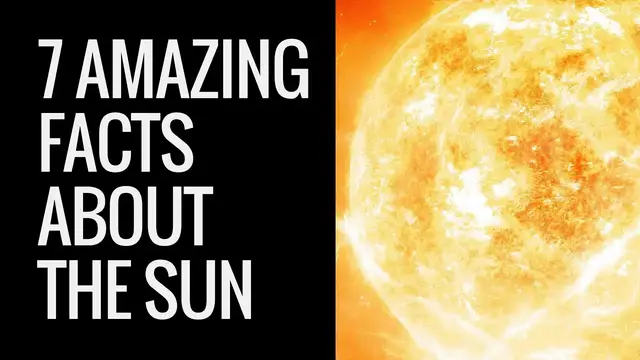

Interesting Facts About The Sun | Sun Facts For Kids | 7 Unknown Facts About Our Sun
Oct 27, 2023

Interesting Facts About The Sun | Sun Facts For Kids | 7 Unknown Facts About Our Sun
Visit https://bit.ly/3LMHLfi for interesting space-related information.
The Sun is a G-type main-sequence star and it is informally referred to as a yellow dwarf. It formed approximately 4.6 billion years ago.
The Sun is the star at the center of the Solar System and is the most important energy source on Earth.
It is a nearly perfect spherical ball of hot plasma with a diameter that is about 109 times that of Earth.
It has a mass about 330,000 times that of Earth, accounting for about 99.86% of the total mass of the Solar System.
Here are some interesting facts about the sun:
Do you know that 1.3 million Earths could fit inside the Sun:
If a hollow Sun was filled up with spherical Earths then around 960,000 would fit inside. On the other hand if these Earths were squished inside with no wasted space then around 1,300,000 would fit inside.
The Sun’s surface area is 11,990 times of the Earth’s surface area.
After some time, the Sun will consume the Earth:
The Sun will continue to burn for about 130 million more years, burning Helium, during which time it will expand and will engulf Mercury and Venus and the Earth. At this stage it will have become a red giant.
The Sun will one day be about the size of Earth:
When this happens, it will be called a white dwarf.
The Sun contains 99.86% of the mass in the Solar System:
The mass of the sun is approximately 330,000 times greater than that of Earth.
Interesting Facts About The Sun | Sun Facts For Kids | 7 Unknown Facts About Our Sun
https://www.youtube.com/watch?v=FuobvgiF-v8
It is almost three quarters Hydrogen, whilst most of the remaining mass is Helium.
There is only a 10 kilometre difference in its polar diameter compared to its equatorial diameter. Considering the vast expanse of the Sun, this means it is the closest thing to a perfect sphere.
Light from the Sun takes eight minutes and 20 seconds to reach Earth:
The average distance between earth and sun is around 150 million kilometres.
The Sun travels at 220 kilometres per second:
The Sun is 24,000-26,000 light years from the galactic centre and it takes the Sun 225-250 million years to complete an orbit of the centre of the Milky Way.
The distance from the Sun to Earth changes throughout the year:
The distance between the two bodies varies from 147 to 152 million kilometres as the Earth travels on an elliptical orbit around the Sun.
The distance between the Earth and the Sun is called an Astronomical Unit (AU).
The Sun generates solar wind:
Here are some related videos:
Planet and planetary facts
https://www.youtube.com/watch?v=xGa9VErg-Ak&list=PLeHdlMCQ8yHTQ_V-9A3XOEcDKQDSjB3T7
Interesting Facts About The Moon
https://youtu.be/-4DuzItWPmI
Interesting Facts About planet Mercury
https://youtu.be/C1BkpntPSec
Interesting Facts About Planet Earth
https://youtu.be/rxZTaWov2o4
Interesting Facts About planet Mars
https://www.youtube.com/watch?v=xGa9VErg-Ak
Interesting Facts About Planet Jupiter
https://youtu.be/RcQ4Ccf7Q00
Interesting Facts About planet Saturn
https://youtu.be/CVn2F3uMCcY
Interesting Facts About neptune
https://youtu.be/8Mkoqdhp4tQ
Interesting Facts About Pluto
https://youtu.be/-t9aDwyutPQ
Show More Show Less