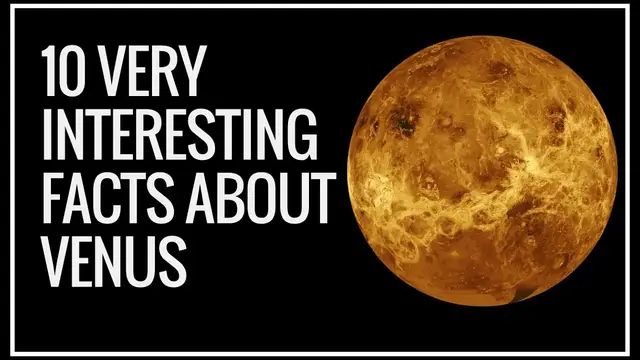

Venus Facts | Venus Facts For Kids | 10 Amazing Facts About Venus
Oct 27, 2023

Venus Facts | Venus Facts For Kids | 10 Amazing Facts About Venus
Visit https://bit.ly/3LMHLfi for interesting space-related information.
Venus is the second planet from the Sun and is the second brightest object in the night sky after the Moon. Venus is named after the Roman goddess of love and beauty. It is the second largest terrestrial planet and is sometimes referred to as the Earth’s sister planet due the their similar size and mass. The surface of Venus is obscured by an opaque layer of clouds made up of sulphuric acid.
Here are some interesting facts about the planet Venus
A day on Venus lasts longer than a year.
It takes 243 Earth days to rotate once on its axis. The planet’s orbit around the Sun takes 225 Earth days, compared to the Earth’s 365.
Venus is often called the Earth’s sister planet.
Venus rotates in the opposite direction to most other planets.
This means that Venus is rotating in the opposite direction to the Sun, this is also known as a retrograde rotation.
Venus is the second brightest object in the night sky.
Only the Moon is brighter. With a magnitude of between -3.8 to -4.6 Venus is so bright it can be seen during daytime on a clear day.
Atmospheric pressure on Venus is 92 times greater than the Earth’s.
Venus is also known as the Morning Star and the Evening Star.
Venus is the hottest planet in our solar system.
The average surface temperature is 462 °C
As Venus does not tilt on its axis, there is no seasonal variation.
The Russians sent the first mission to Venus.
At one point it was thought Venus might be a tropical paradise.
The dense clouds of sulphuric acid surrounding Venus make it impossible to view its surface from outside its atmosphere.
There are more volcanoes on Venus than on any other planet in the solar system.
Venus is rare among the planets in that we can see it cross in front of the sun. Only Venus and Mercury do this from the vantage point of Earth. It is also called Venus Transit.
Winds swipe across Venus at super-fast speeds that can reach 450 miles an hour (724 kph) in its middle cloud layer. These Venusian winds are faster than the speediest tornado on Earth.
Venus appears to have phases like the moon.
The first person to witness these phases was Italian astronomer Galileo Galilei in 1610.
Here are some related videos:
Planet and planetary facts
https://www.youtube.com/watch?v=xGa9VErg-Ak&list=PLeHdlMCQ8yHTQ_V-9A3XOEcDKQDSjB3T7
Interesting Facts About The Moon
https://youtu.be/-4DuzItWPmI
Interesting Facts About The Sun
https://youtu.be/FuobvgiF-v8
Interesting Facts About planet Mercury
https://youtu.be/C1BkpntPSec
Interesting Facts About Planet Earth
https://youtu.be/rxZTaWov2o4
Interesting Facts About planet Mars
https://www.youtube.com/watch?v=xGa9VErg-Ak
Blue Sun sets Of Planet Mars
https://youtu.be/wTpt1U-hXFM
Interesting Facts About Planet Jupiter
https://youtu.be/RcQ4Ccf7Q00
Interesting Facts About planet Saturn
https://youtu.be/CVn2F3uMCcY
Interesting Facts About Neptune
https://youtu.be/8Mkoqdhp4tQ
Interesting Facts About Pluto
https://youtu.be/-t9aDwyutPQ
Show More Show Less