We use affiliate links to run our site. When you buy through links on our site, we may earn an affiliate commission, without any added cost to you. Learn more
Mushroom cultivation often remains an overlooked aspect of gardening. While it may not garner as much attention as popular crops like tomatoes or squash, growing mushrooms proves to be remarkably uncomplicated, flexible, and highly beneficial.
If you’re seeking a beginner-friendly and delectable variety, white button mushrooms are an excellent choice.
In this article, we will delve into the art of growing mushrooms, offering valuable insights and essential information to help you get started on this exciting journey.
Keep reading to discover the secrets of cultivating these tasty fungi and gain a deeper understanding of mushroom cultivation.
Table of Contents
How Do Mushrooms Grow?
Unlike most other plants, mushrooms don’t grow from seeds but from spores.
The mushroom spores are very tiny and you can’t see them with the naked eye. So, the thing we use to grow mushrooms is called spawn, it is a blend of mushroom spores and some substrates.
The life cycle of a mushroom starts with a spore that produces a primary mycelium. When the mycelium originates from two spore mates, a secondary mycelium is produced. This mycelium continues to grow vegetatively.
When vegetative mycelium has matured, it culminates in the mushroom fruit body. The fruit body is the last growth stage of the mushroom.
Ideal Growing Conditions For Mushrooms:
A dark, cool, and moist environment is ideal for mushrooms. Depending on the variety the ideal temperature ranges from 45 to 60 deg F. A little bit of light won’t do a lot of harm to the plant but make sure most of the time the light is absent.
One of the easiest ways to start growing mushrooms in your home is to buy Mushroom kits. The best part of a kit is it is already packed with the growing medium and the spawn.
You can grow mushrooms in trays, bags, or boxes. You can also use garden beds to grow them.
Types of Mushrooms:
Some of the most popular mushroom types are:
- White Button Mushroom
- Shiitake Mushroom
- Oyster Mushroom
- Portobello mushroom
- Morel Mushroom
Where to Grow Mushrooms:
Mushrooms don’t like soil as a growing medium and they thrive on things like coco coir, sawdust, grain, straw, or wood chips.
Not all mushrooms like the same substrate. Depending on the variety they may prefer straw, cardboard, logs, or wood chips. Some mushrooms also like compost with a blend of straw, corncobs, and cocoa seed hulls.
For white button mushrooms, for example, you need composted manure, shiitakes on the other hand grow on wood or hardwood sawdust and oyster mushrooms prefer straw.
Learn how to cultivate healthy, organic, natural mushrooms at a fraction of the cost of store-bought ones with this step-by-step mushroom growing guide.
How to Grow Mushrooms:
First, select the mushroom you want to grow in your home. The next most important step would be to determine the substrate on which you should grow the mushrooms. It is very important as each mushroom has its own preference selecting the wrong substrate can result in failure.
Button mushrooms are one of the easiest and most popular types of mushrooms that you can grow in your house. So we will discuss this here.
Stages of Growing Mushrooms:
The different stages involved in growing mushrooms are:
- preparation,
- inoculation,
- incubation,
- fruiting, and
- harvesting.
Preparation involves obtaining or making the mushroom substrate, which is the material that the mushrooms will grow on.
Inoculation involves introducing the mushroom spawn, which is the living fungal culture that will colonize the substrate.
Incubation involves keeping the inoculated substrate in a warm and dark place until it is fully colonized by the spawn.
Fruiting involves exposing the colonized substrate to light, fresh air, and lower temperatures to trigger the formation of mushroom caps.
Harvesting involves picking mature mushrooms from the substrate before they start to decay.
Steps For Growing White Button Mushrooms:
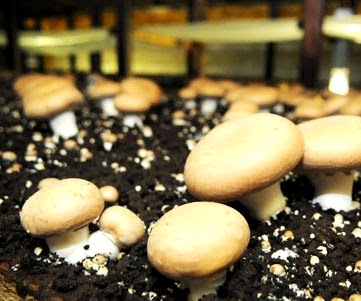
Prepare Your Own Compost:
The first thing for growing white button mushrooms is to prepare the substrate and compost. It is very easy to prepare compost at your home.
Choose your composting ingredients. You will find a variety of composting ingredients in this article. After choosing the ingredients, mix them properly and set them to decompose.
Composting is a slow process so it will take a month or two. So be patient. You can speed up the composting process a bit by following these simple tricks.
Once your compost is ready, take the mixture to a shady place to provide the ideal condition for mushroom growing.
Once you make sure that the temperature of the compost is below 30 deg C you can start the process of spawning.
Use growing trays that are at least about six inches deep. Fill the trays with the mushroom compost material and sprinkle spawn on top.
Keep the compost moist by spritzing it with water and covering it with a damp cloth. Keep spritzing the cloth as it dries.
If done properly within two weeks mycelia will grow in compost. You need to provide good ventilation or install a cooling system because those mycelia will increase the heat in the compost.
You can speed up the fruiting process by covering the top surface of the compost, (also known as casing) with some organic material like compost, peat moss, cow dung, etc.
Harvesting Mushrooms:
Usually, it takes 3-4 weeks before you can harvest button mushrooms.
Harvesting of mushrooms is done in three stages:
1. Buttons: Buttons are small unopened mushrooms and are normally sold for a higher price. This type is not that good in taste and primarily for their appearances only.
2. Cups: Cups are button mushrooms that have grown to a stage where the cap is beginning to open and some gills can be seen. These have a stronger more mature mushroom flavor. They are next best to Flat mushrooms for eating.
3. Flat: Here, the caps are flattened and the gills are fully visible. They are the best in taste.
When the caps start opening, cut the stalk from the stem. The roots of the mushrooms are very shallow. So while harvesting, don’t pull up mushrooms, it can damage the other immature ones that still need some time to develop.
Brush off any dirt or compost that might remain attached to the mushroom.
Conclusion:
So there you are. Now you can easily try your hands at growing mushrooms at your home.
Growing mushrooms at home is a fun and rewarding experience that anyone can do. With a little bit of knowledge and the right supplies, you can grow your own mushrooms in no time.
So what are you waiting for? Give it a try today!
If you like the post don’t forget to share it with others. If you want to seriously grow mushrooms in your home try this easy step-by-step guide on mushroom growing.
Don’t Forget to PIN IT
Frequently Asked Questions(FAQs):
Is it difficult to grow mushrooms at home?
Can I grow mushrooms on a small scale or in a limited space?
What is mushroom spawn, and how is it used in the cultivation process?
Is it necessary to create sterile conditions when inoculating mushroom substrate?
How long does the incubation phase typically last?
What are the ideal fruiting conditions for mushrooms?
How do you know when it’s time to harvest mushrooms?
Can I harvest mushrooms more than once from the same substrate?
What are some popular types of mushrooms that can be grown at home?
Additional resources:
- https://www.bhg.com/gardening/vegetable/vegetables/how-to-grow-mushrooms/
- https://grocycle.com/how-to-grow-mushrooms/
Amazon and the Amazon logo are trademarks of Amazon.com, Inc, or its affiliates.